Essay
Twelfth Night – A New Milestone for the Bayerisches Junior Ballett München
by Deike Wilhelm
For the Bayerisches Junior Ballett München (BJBM), now sixteen years old, an important premiere lies in front of them: for the first time, the young ensemble is taking on a full-length narrative ballet, and with it a host of new challenges. Until now, the company’s programmes have consisted of shorter abstract works from the classical, neoclassical and contemporary repertoire. Now the dancers must embody characters for up to eighty minutes, develop them as the plot unfolds, and tell a story without words that an audience can follow. That demands not only a great deal of imagination and engagement with the material, but also far greater stamina, both physically and mentally. This is a new kind of task for the young dancers, and one through which they are sure to grow as artists.

Choreographer Jörg Mannes, currently ballet director in Magdeburg, is no stranger to the BJBM. After several creations for the Bavarian State Ballet, he choreographed «Unsterbliche Geliebte» (Immortal Beloved), set to music by Ludwig van Beethoven, for the junior company in 2021, to great acclaim. Shakespeare’s comedy is familiar territory for him too. “This is my third version of Twelfth Night. I do this often, because when I’ve finished creating a ballet, I often feel that only now do I truly understand the material in all its depth. And then the next version turns out differently again,” says Mannes. For a choreographer, that means digging ever deeper into the plot, the characters and their dynamics, and telling the story with increasing clarity. “Musically, this version is closer to my previous version in Magdeburg. Even so, it’s new again, because I like to work with the language of the dancers in front of me. It changes and develops a great deal depending on who I’m working with. So the ballet is different every time, even if the title stays the same.”
This approach has surprised the young dancers, as Ata Naci Aktaş from Turkey explains: “Since we were learning a piece that had already been staged, I assumed he would simply teach us the choreography and refine the sequences. But that wasn’t the case. The whole process was shaped by the way he tailored the choreography to each of us, to our strengths and our personalities.”
Mannes’ ballets are mostly narrative, and it matters greatly to him that every step and movement serves the storytelling, so that a spectator can follow the plot without having to know the details of Shakespeare’s comedy. He passed this on to the dancers during rehearsals. When the first rehearsal phase began in June 2026, Mannes’ initial aim was to bring the story close to them. Each new scene was explored in terms of its content before it was danced: what the scene is really about, and what intentions and motivations drive the characters within them. The young dancers came to understand that a narrative ballet calls for a different approach, as ensemble member Olja Aleksić from Serbia explains: “For years I danced choreography that demanded precision in the steps first and feeling only afterwards. In a narrative ballet, as I’ve learned from Jörg, the word and the emotion come first. Only then do we become truthful and human, and merge completely with our roles.”


Mannes encouraged the dancers to immerse themselves in their characters, a new challenge for young people most of whom have only just finished their professional training. Brazilian dancer Mateus Gati describes it vividly: “For the first time in my career, I’m being asked to create a profound character role and to unite art and technique inseparably within it. When I concentrated fully on the character’s psychology and artistic expression in rehearsals, technical precision sometimes slipped. That is exactly the challenge for us young dancers: to find the perfect synthesis and bring everything together, the steps, the technique and the artistry.” The juniors’ earlier abstract repertoire demanded not only technique but also sensitivity, commitment and a personal dance expression. Taking on a character adds another layer. The dancers must delve deep into an individual’s psychology, but also consider how the characters relate to others and to deal with the situations they find themselves in, whether by choice or not.
In search of her character, French dancer Rose Perrot turned to Baroque painting: “I was especially inspired by the paintings of Artemisia Gentileschi and Guido Reni’s ‘Cleopatra’. They show women who suffer in a deeply dramatic way, yet remain strong and powerful. The way pain, vulnerability and dignity coexist in these paintings inspired me to create a character who can make all of those emotions tangible in a single solo.”
When the curtain rises on the first performance of «Was ihr wollt» (Twelfth Night), the audience will not be able to see or name every layer of preparation and artistic exploration the dancers have gone through. But they will sense the seriousness and depth with which the young artists have approached their characters and the work. They will understand the characters and the story, and feel them.

To ease this large and unfamiliar artistic task for the young dancers, Mannes chose Shakespeare’s comedy with their age in mind. He is convinced that young people easily identify with the protagonists and their feelings. In his view, the rapid swings of emotion, above all falling in love quickly, jealousy and passion, and the sense of being overwhelmed by feeling, are distinctly youthful. As life goes on, he says, we mostly grow more realistic.
This turbulent comedy of mistaken identities was written by Shakespeare around 1600 as a carnival play. Its title refers to the twelfth night after Christmas, the eve of Epiphany. In Shakespeare’s Elizabethan England, this was the high point of the winter festivities, a traditional celebration much like a carnival, on which the social order was ritually turned upside down. Accordingly, in «Was ihr wollt» (Twelfth Night) gender roles are swapped, a maidservant and members of the household staff play a prank on the steward, and only the fool sees through the tangle of love affairs.
The play opens with a shipwreck off the coast of Illyria. The young Viola makes it ashore and believes her twin brother Sebastian has drowned. To survive alone in a foreign land, she disguises herself as a man and, calling herself Cesario, enters the service of Duke Orsino. He sends her to woo Countess Olivia on his behalf, a woman who has shut herself away from the world in deep mourning for her dead brother.
The emotional chaos soon follows:
Viola falls hopelessly in love with her master, Orsino.
Duke Orsino pines in vain for Olivia, yet feels strangely drawn to his new page, Cesario (the disguised Viola).
Countess Olivia rejects the Duke but falls head over heels for the charming messenger Cesario, never suspecting that he is a woman in disguise.
While this love triangle tightens, Olivia’s household stirs up trouble of its own. Her hard-drinking uncle, Toby, and the crafty maid Mary play a cruel game on the strait-laced steward Malvolio, exposing him to ridicule with a forged love letter. They are aided by Andrew, a foolish and cowardly knight. Toby only tolerates him for his money, and persuades him that he has a real chance of winning Olivia’s heart.
When Viola’s brother Sebastian, long believed dead, finally appears, the twins’ uncanny resemblance tips the story into absurd chaos: mistaken identities, duels and spontaneous weddings. Egged on by Toby, the jealous Andrew challenges his supposed rival Cesario to a duel. But instead of the disguised Viola, he faces the far more capable Sebastian, who promptly defeats him.
Amid all the entanglements, Feste the fool remains the sharpest mind in the play. While the nobles sink into lovesick delusion, Feste has the licence to tell everyone the plain truth to their faces. Feste sees through everyone’s masks and is the only character to address the audience directly.


Mannes has pared this complex plot down to its essentials, since ballet must do without words and still tell a story clearly. “The difficulty with dance is telling real events at a level of abstraction,” he says. “But that is exactly what I love. Dance makes our inner world of thoughts visible. Words can lie, but the body doesn’t. When a ballet tells a story, it is something very real and deeply personal.” He also makes deliberate use of the power of music, drawing on a great many different pieces to reflect the constantly shifting emotions. Much of the music comes from the Italian cellist and composer Giovanni Solima, whose lively scores change mood just as often. Some pieces by Max Richter bring out the emotional depth. And Mannes uses the strict structure of the minimalist Philip Glass to step outside the story at certain moments and view the action in the abstract.
For Mannes, dance is an extension of body language and therefore honest and immediate. A dancer’s personality is inseparable from their body, so the audience always feels it as well. “Dance,” he says, “has a very special sincerity. Even in the most abstract moment, a dancer on stage is always telling a part of their own life story. The way we move is primal and deeply instinctive. I try to help the dancers let go of the purely ‘dancer’s perspective’. Because of their ballet training, they often focus intensely on their feet, their extension and their technique. What I want is that they connect with their instinctive understanding, and for audiences with no formal dance training who observe the action onstage very differently. That’s the beauty of dance: you can express something without any explanation or justification. It is absolutely direct.”
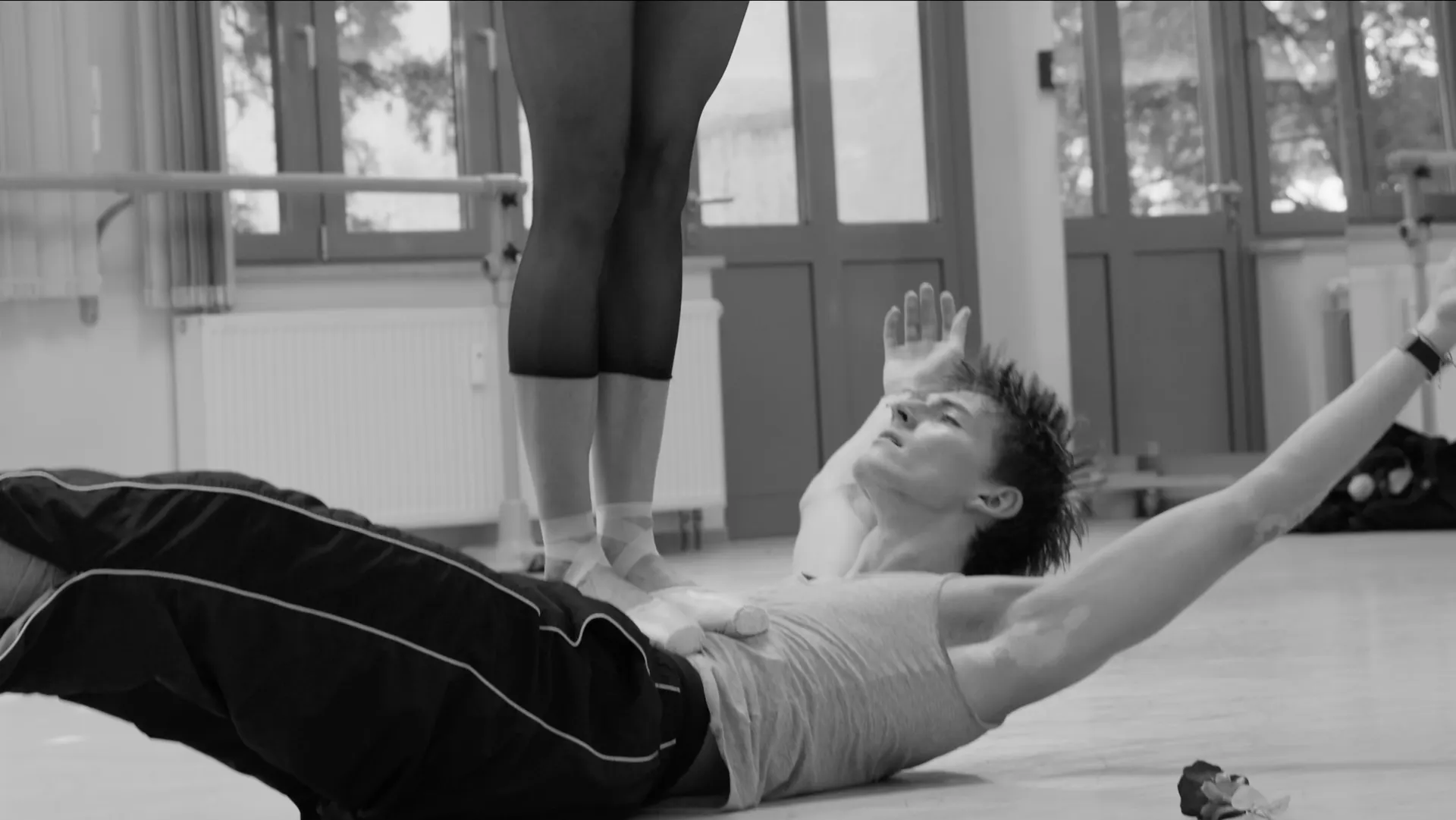
The audience can therefore look forward to a lively, layered and deeply moving performance, and to seeing how the young dancers rise to this new challenge. Several touring venues have already shown great interest in the juniors’ first full-length narrative ballet, which gives the young artists a wonderful chance to go deeper into their characters and the work through frequent performances. Munich audiences will see how this experience helps the BJBM dancers grow: when they prepare new pieces for the Spring Matinees 2027, their artistic expressiveness and maturity will be clearly visible. And it will be especially exciting in June 2027, when the juniors present the full-length version of «Was ihr wollt» (Twelfth Night) at the Prinzregententheater.
One can only congratulate the BJBM on taking on this great task. Artistically and educationally, it is certainly a milestone for the whole ensemble and team. Even during rehearsals, the young dancers can see the point of all their hard work, as Apolline Hartz from France sums up so well: “This process showed me clearly that an outstanding performance is not just a matter of technique. It’s equally about embodying a person, a role, a character. To do that, I had to understand the story thoroughly, so that every movement carries meaning and the audience truly grasps what is happening on stage.”
This work also shows why these young dancers are on stage: not merely to dazzle and impress with first-class technique, but above all, as artists, to touch their audience’s hearts and keep people open and receptive to one another. Let’s get swept away!